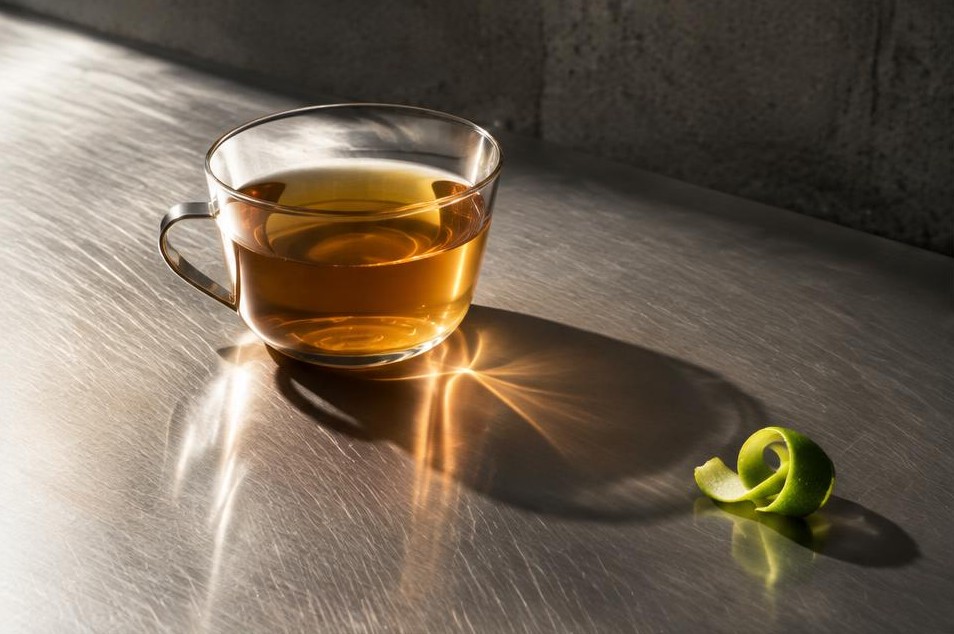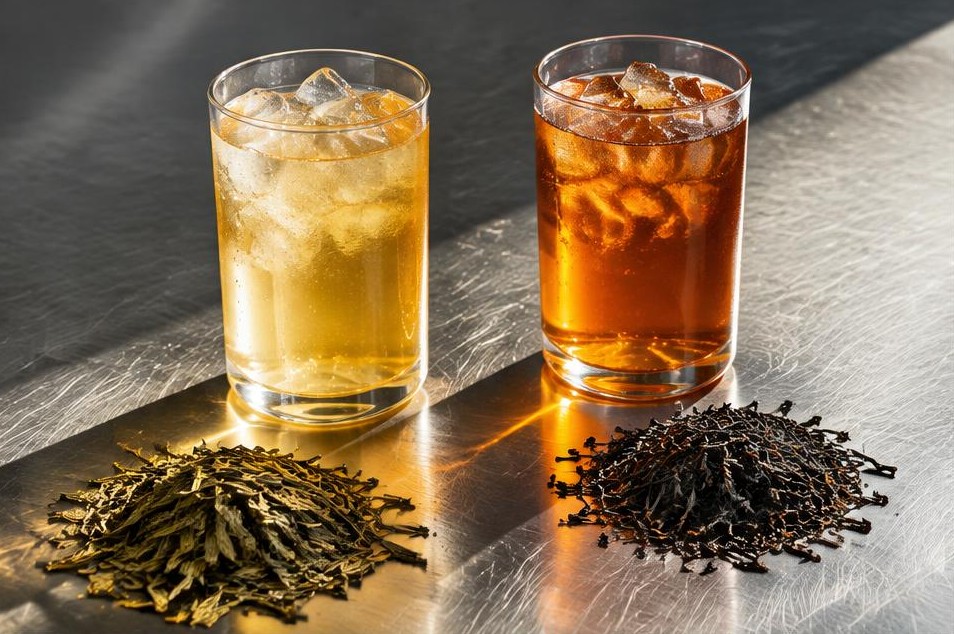
“Iced” tells you the tea arrives cold. It leaves out almost every decision that got it there. A strong hot brew poured over ice and a tea steeped in the fridge can sit beside each other on a table looking much alike. If you intend to add peach, lime or a measure of soda, the distinction matters. Taste the tea on its own first. You may find that one can carry the addition and the other is already exactly where you want it.
In 2025, Chen Yang and colleagues compared green tea brewed at 4°C with a hot preparation at 80°C. They looked at the compounds that entered the water as well as the character of the drink. Under their conditions the cold brew took time to develop its flavour, with a characteristic profile emerging after about an hour. The researchers found slower extraction of certain bitter compounds, including caffeine, and described floral and savoury qualities in the cold infusion. A glass made with a different tea, dose or steeping time can give a different result. You cannot read a caffeine dose off the words “cold brew”. 1
Water complicates the picture in its own right. In 2026, Yutong Ye and colleagues compared four waters for cold brewing green tea. Their mineral water sample gave a darker, flatter tasting infusion. Pure and distilled water produced more caffeine and catechins, compounds associated in their study with a more bitter, drying impression. This is a good reason to use the same drinking water when comparing brews. The findings apply to those waters and that tea. 2
For a quick iced tea, follow the leaf supplier’s hot brewing temperature and timing. Make a stronger infusion to allow for the ice, strain, then pour over clean ice in a heatproof jug and serve. The University of Wyoming’s extension service uses this approach to cool tea quickly. For a cold infusion, choose tea sold for cold preparation, steep it covered in the fridge using clean equipment and drinking water, and follow the packet’s timing. Follow hot brewing instructions on ordinary dried fruit or herbal infusions. Germany’s Federal Institute for Risk Assessment advises boiling water and at least five minutes for conventional herbal and fruit teas. [3, 4, 5]
At the table, taste both preparations equally cold and without ice still melting in one of them. Pay attention to what happens between sips. Does the tea leave a drying feeling on the inside of your cheeks? Does its scent linger after you swallow? Add a little peach juice to a spoonful of each. The tea you preferred to drink plain might be the one you would rather keep for yourself, just as it is.
- Chen Yang and colleagues, 2025. How cold brewing changed the aroma and taste of green tea
- Yutong Ye, Lingfei Ji and Yiyang Yang, 2026. A comparison of four waters used to brew green tea cold
- Vicki Hayman, University of Wyoming Extension, reviewed 2024. Preparing iced tea with a stronger hot brew
- CVUA Karlsruhe, Baden Württemberg. Food laboratory investigation of teas sold for cold preparation
- German Federal Institute for Risk Assessment. Preparation guidance for ordinary herbal and fruit infusions