Imagine a chef saying the second tea is brighter. Someone from reception nods. The person who made it explains that the second batch had more leaf. By the time the hotel manager picks up a glass, the room has supplied an adjective, a reason and a preferred answer. The tea itself has had surprisingly little to say.
Move that conversation to the end and the next half hour gets much more interesting. The following is a class you can run at a kitchen table or before service. It has two rounds. In the first, each person tries to pick the odd cup. In the second, each chooses which drink they would serve. Keep the slips until you have finished both rounds. Someone can quite honestly pick the odd drink and then tell you they prefer the other one.
Decide what the kitchen needs to know
Suppose you serve iced black tea with breakfast. The chef would like a little more character once the tea is cold. The team proposes increasing the quantity of leaf. You have two questions. Can people actually tell the two teas apart at the temperature you serve them? If so, which would they like to keep drinking alongside breakfast?
Sensory scientists give those questions different tests. ISO 4120 describes the triangle test, which asks people to identify the odd one of three samples drawn from two products. A triangle can tell researchers about a perceptible difference. It cannot tell them which recipe tastes better. The Society of Sensory Professionals likewise distinguishes tests of difference from tests of liking. A handful of people from the same kitchen can use the idea to make a better prototype decision. To learn what paying guests prefer, at some point you need to ask paying guests. [1, 2, 3]
Write the question on the back of the recipe card before touching a kettle. For this class, use Can our group tell these two brews apart when both are served cold? If your real question is whether anyone wants iced tea with eggs, start with eggs. You will save yourself an afternoon perfecting the wrong thing.
Put one difference in the jug
For the exercise, brew one jug with 4 g of your usual black tea and 500 ml of water, and another with 6 g of the same tea and 500 ml. These are teaching quantities. Follow the supplier’s hot brewing directions for time and temperature, apply them to both, strain into matching containers, then cool promptly and refrigerate together. Taste the two at the same cold serving temperature. Leave out the lemon slice, the ice cubes and the brand names for this first round. Use clean equipment, potable water and a fresh cup for every sample. Tell tasters what the samples contain, including caffeine, before they choose to take part. Nobody needs the identities of the two recipes yet.
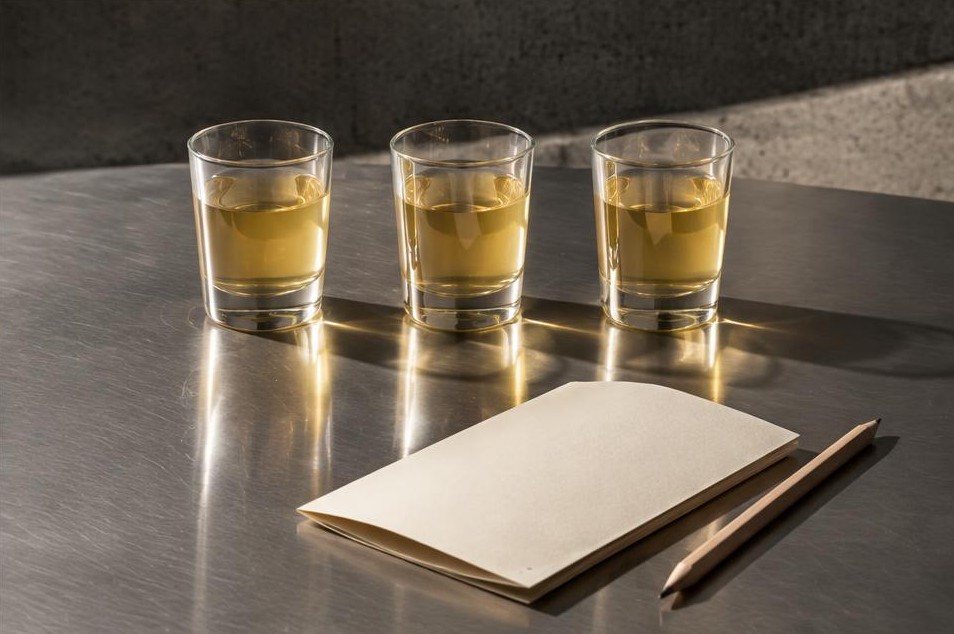
Ask one person to serve and keep the key. Use a tray, a pencil and identical opaque cups. A darker tea can give away the odd sample on sight. For six people, three 20 ml pours each use 360 ml in all for the first round. An even split of the six arrangements uses 180 ml from each jug. Another 20 ml of each tea for each person adds 120 ml per jug in round two. You need 300 ml of finished tea from each jug across both rounds, with room in the original quantities for straining and pouring losses. Photograph or write down the brew settings so the kitchen can make the preferred one again.
Make it possible to get the answer wrong
Call the jugs A and B on the server’s sheet. Give each cup its own unrelated three digit number on the taster’s side. If both pours of the same tea carried the same number, everyone could solve the puzzle by looking down. The arrangements below distribute the odd cup across all three positions. Mix up the rows before assigning them. Keep the letter columns out of sight. The Society of Sensory Professionals describes the six arrangements and recommends varying the order across tasters. 2
| Tray | First cup | Second cup | Third cup | Server’s answer |
|---|---|---|---|---|
| 1 | 417 · A | 683 · A | 259 · B | 259 |
| 2 | 726 · A | 398 · B | 541 · A | 398 |
| 3 | 854 · B | 261 · A | 739 · A | 854 |
| 4 | 382 · B | 915 · B | 647 · A | 647 |
| 5 | 573 · B | 842 · A | 316 · B | 842 |
| 6 | 629 · A | 453 · B | 781 · B | 629 |
Serve all three at once. Give everyone plain water. Ask them to taste from left to right, return to a cup if they wish, and write down one number even if they have to guess. Let them circle quite sure or guessing for their own interest. The answer still counts the same. Everyone writes before anybody speaks. The cook who made both jugs can have a tray later from someone who knows how to rearrange it.
Why bother hiding a recipe change this small? In an experiment published in 2008, Hilke Plassmann and colleagues had 20 people taste wines while looking at prices. Two of the wines appeared twice under different prices. On average, people rated the same wine as more pleasant when it was paired with the higher price. One wine was presented at both $10 and $90. It was a small experiment about wine, conducted in a scanner. It gives a host a good reason to leave the story about expensive tea for the conversation afterwards. 4
Bring breakfast back into the room
Collect the first slips. Issue two fresh cups with new codes, one of each brew. Give three tasters the lighter tea first and three the stronger tea first. Add a bite of the food the tea will accompany and ask everyone to try both. This time ask one question about the actual service decision. Which would you want as a full glass with this breakfast? Let people write either or neither if that is how they feel. A reluctant vote is of little help to the kitchen.
There is space for one sentence under the choice. A specific moment is worth recording. Someone might like the first sip of the stronger tea and find it heavy after eating. Someone else might prefer the quieter tea alone and lose it against the food. Those are examples of comments to listen for. Leave the example adjectives off the printed sheet so people get to choose their own words.
| A slip to print | What the taster fills in |
|---|---|
| Round one | The cup that seemed different was ______. I was quite sure / guessing. |
| Round two | With this food I would choose cup ______ / either / neither. |
| One detail I would want the maker to hear | ______________________________ |
Read what the room actually told you
Imagine that four people out of six picked the odd cup. The answer is a count. A guess has a one in three chance of being right, so some correct answers would occur even if nobody could distinguish the teas. With only six independent responses, four correct falls short of a conventional one sided 5% significance threshold. If all six people guessed independently, about one tasting in ten would produce four or more correct answers by chance. Calling that a decisive win would overstate what happened. Calling the recipes identical would go beyond the result too. The working decision can be inexpensive. Try the two again on another service, with another group, before spending money or changing the menu. [1, 2]
Read the second slips separately. Imagine three people chose the lighter tea with food, two chose the stronger and one wrote either. Record exactly that. The comments might give you a better next move than the vote. If two people say they would order the stronger tea in a smaller glass, the next test could be a question about portion. Keep a dated note explaining why that became the question. If you change the glass and the brew at once, you will have to untangle them later.
Hand something usable to the next shift
Hand the next shift a recipe card with the leaf, water, brewing time and temperature, finished yield, cooling method and service glass. Add the food you tasted alongside it. Note who was in the room by role if that matters to the decision. Six staff tasting before breakfast tell you something about those six staff before breakfast. On a later service, invite guests who order the tea to say what they would change. Log their own wording alongside the date, without pressing anyone for a compliment. 3
Keep one last space on the card for a decision. Continue trialling the stronger brew with savoury breakfast is enough. So is Keep the current tea. Add one more line in the maker’s handwriting. The next time we pour this, we want to find out whether ___. The breakfast shift can pick up where the tasting ended.
- International Organization for Standardization, ISO 4120:2021, public scope of the triangle test, reviewed in 2026
- Society of Sensory Professionals, the triangle test, sample orders and chance probability
- Society of Sensory Professionals, study design, preference, blinding and the limits of a sample
- Hilke Plassmann and colleagues, original price cue experiment, Proceedings of the National Academy of Sciences, 2008