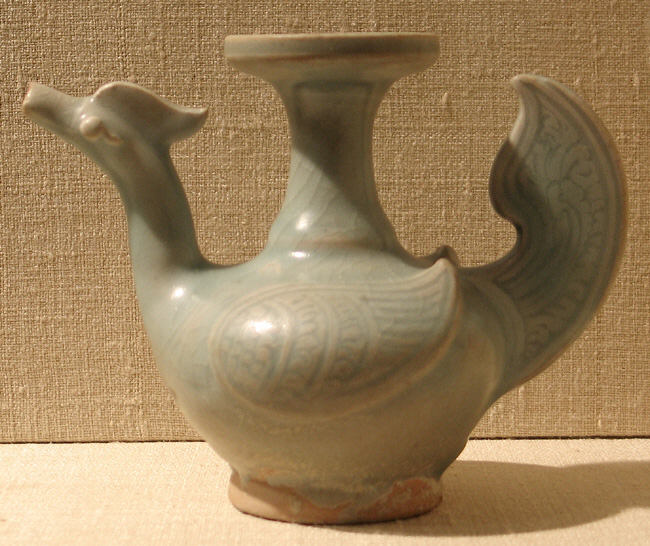
The bird is just 11.5 centimetres high. Its wings are folded. Its beak points back towards its body, well clear of the business of getting a drink. Look lower, at the centre of its breast. What might pass for a rather large button has a dark opening. Above it, between the wings, a wide ceramic collar opens at the top. Water goes in above and comes out below. [1, 2]
The Metropolitan Museum of Art calls the little gander a kendi. A kendi has a filling mouth and a separate pouring spout. Traditionally you can hold the neck, tilt the vessel and direct a stream towards your mouth, leaving a gap between your lips and the spout. Picture the gesture and the missing handle makes sense. So does the space the potter left around the upper collar. Your hand has somewhere to go. [2, 3]
The Met attributes this example to Si Satchanalai in Thailand and dates it somewhere between the fourteenth and the middle of the sixteenth century. Examine the museum photograph close up. A few brown strokes describe the feathers. The rim of the spout and the lip at the top have much the same pale glaze as the body. The potter has given you two ways to read the shape. From across a table you might see a bird. From the place where you would put your fingers, you can see the jug. 1
A second Thai kendi in the Smithsonian’s National Museum of Asian Art makes a revealing companion. It is sixteenth century earthenware from the Sawankhalok kilns at Si Satchanalai, with red stripes on bare clay and black paint on the neck. No bird here. The small foot, projecting spout and tall neck make the family resemblance easy to spot. Pull both photographs up together and cover the heads of the vessels with your thumb. In each case the low, rounded body carries the liquid while the spout stands clear of it. 4
Another maker at Sawankhalok used the curved surface quite differently. A stoneware kendi in Los Angeles carries painted bodhisattvas with palms together, floral forms and a checkerboard pattern. The museum records both everyday and ceremonial uses for vessels of this family. There is room for a sacred figure and for a goose in the history of the same practical idea. 5
Next time a jug lands on your table, see where you reach before you think about it. The handle, the neck and the broad base all propose different gestures. Somewhere in Si Satchanalai a potter worked out how to make the right gesture occur to a stranger, and still left room for wings.
- The Metropolitan Museum of Art, Kendi in the Form of a Hamsa (Gander), object 1989.238.53
- Powerhouse, curator Min Jung Kim on the openings and use of a kendi
- Asia and Pacific Museum in Warsaw, The Many Faces of Water in the Cultures of Asia and Oceania, entry on the kendi
- Smithsonian National Museum of Asian Art, Kendi, object S2005.344
- Los Angeles County Museum of Art, Water Vessel (Kendi) with Bodhisattvas