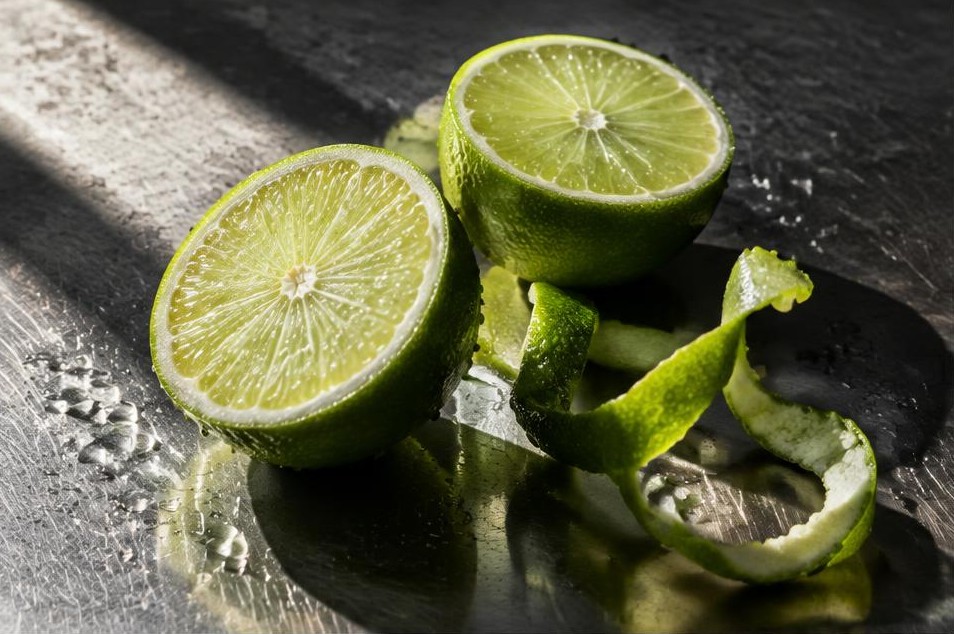
Hold a clean, dry spoon under a strip of lime peel. Turn the green side towards the spoon and bend the strip back on itself. Now tilt the spoon towards the light. The little specks on the metal came from the skin of a fruit whose flesh you have yet to touch. Smell the spoon. Then cut the lime, squeeze a little juice into a second spoon and taste a drop. If a recipe simply says “add lime”, which of those two experiences did its author have in mind?
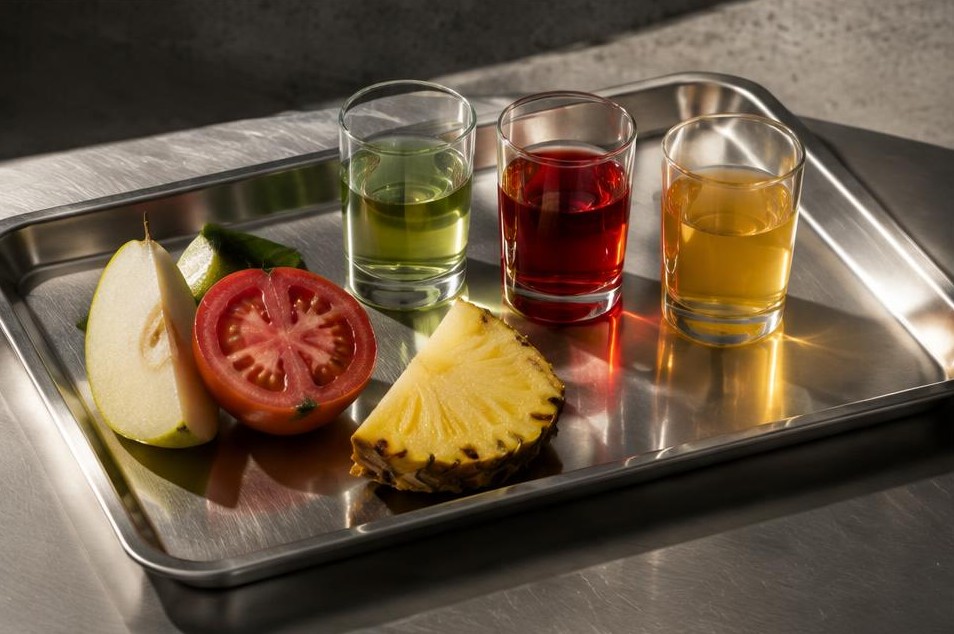
It matters the moment you make a drink that seems to be missing something. A sweet pineapple juice might welcome a squeeze. A glass of tart pineapple juice might already have plenty of bite and still smell faintly dull. Reach for the same half lime in both cases and one of those drinks is going to get a great deal sharper.
Where the spray comes from
In 2018, engineers at the University of Central Florida filmed citrus peel as they bent it. Beneath the coloured skin sit tiny pockets of oil. Bending compresses the softer material around those pockets. Pressure builds until the outer surface gives way and oil shoots out. This explains why folding a strip over a drink does something that balancing a neat wheel of lime on the rim may never do. The skin is a remarkably good little sprayer, if you actually press it. 1
What lands on the spoon is a mixture. Mary Chisholm and her colleagues studied oil from the peel of key limes. They separated its constituents and used both instruments and the human nose to identify the ones with an odour. They detected more than 50 in the extracted oil. Three, geranial, neral and linalool, contributed much of its fresh citrus and floral character. Distilling the oil gave it a different profile, including woody and spicy notes. Even with a single variety, the method changed what the researchers could smell. 2
Juice tells a different story. In a study led by Kristina Penniston, the fresh lime juice analysed contained about 1.4 grams of citric acid per 30 millilitres. That figure describes their sample. It does give you an idea of what a generous squeeze can bring to an already tart drink. Juice carries aroma as well, of course. The point of separating the parts in the kitchen is that you can change the proportions yourself. 3
Two chances to smell a drink
Lift a glass to your face and you smell what reaches your nose from above the liquid. Take a sip and there is another route for its aromas, from the mouth towards the back of the nose. K. J. Burdach and Richard Doty studied this second route. Eight volunteers received solutions flavoured with orange or rum extract. They perceived the odour more strongly when they moved their mouths or swallowed than when they held still. It is worth waiting a moment after a sip before deciding what it tasted like. 4
Try it with three little cups and some chilled watermelon juice. Pour 50 millilitres of the same juice into each. Leave the first alone. Stir half a teaspoon of lime juice into the second. Over the third, fold a piece of freshly cut peel, green side down, then put the peel aside. Smell all three before you sip. Which announces the lime first? Which makes your mouth water? Which still tastes most clearly of watermelon after you swallow?
Then make a fourth cup by mixing a spoonful each of the second and third samples. The squeeze and the twist can work together. If you like the fourth cup, repeat it with a fresh base and measure what you actually use. The quantity of juice is easy to record. For the peel, note roughly how wide a strip you took, how close you held it and whether it went into the glass. A strip resting against your nose throughout a drink is a different instruction from a strip that leaves the room after one squeeze.
What to ask of a lime
Lime appears in two of the founding ELIXIRS recipes. Red Aura pairs it with watermelon and mint. Citrus Soul puts it beside pomelo and young coconut water. Neither list gives away the proportions, and the tasting above is a way to explore one fruit rather than reproduce either juice. What lime needs to do alongside watermelon changes when another citrus fruit is already in the glass. 5
Next time a drink tastes unfinished, keep enough for a second glass. Give one a little juice and the other a twist. Smell each, take a sip and give it a second. If one makes you think “that needed lime” and the other makes you think “now I can taste the watermelon”, you have learned something worth writing on the recipe.
- Nicholas M. Smith and colleagues, University of Central Florida, 2018. Experiments and photographs of oil escaping from citrus peel
- Mary G. Chisholm and colleagues, 2003. Aroma compounds in extracted and distilled key lime oils
- Kristina L. Penniston and colleagues, 2008. Measurements of citric acid in fresh juice and commercial drinks
- K. J. Burdach and R. L. Doty, 1987. How mouth movements and swallowing affect the perception of aroma
- ELIXIRS. Ingredients and status of the founding collection