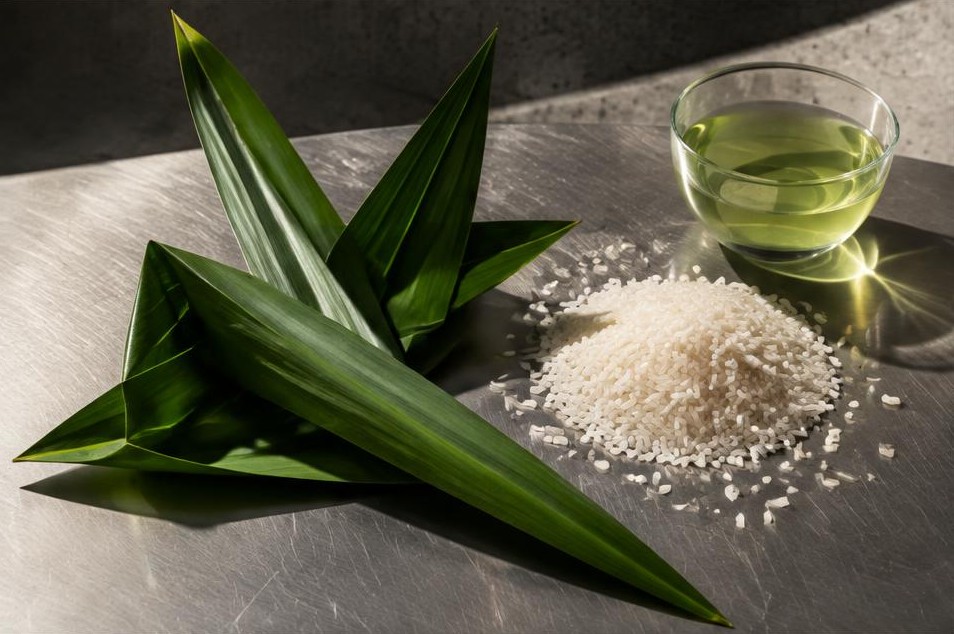
There is a particular pleasure in lifting the lid on a pot of fragrant rice. If that first breath of steam reminds you of pandan, your nose has picked up a real resemblance between a blade of green leaf and a handful of pale grains. They share an aroma compound usually shortened to 2AP. You might recognise its scent as pandan, warm rice or popcorn, depending on what you grew up eating. 1
In a study published in 1993, Varaporn Laksanalamai and Sarath Ilangantileke worked with pandan bought at a market in Thailand and fragrant rice from the northeast of the country. The variety was Khao Dawk Mali 105. The researchers compared fresh and stored rice with pandan, finding a stronger signal for the compound in the fresh fragrant rice than in the stored sample. Later work at Chiang Mai University answered another question. Could that scent already be in the uncooked grain? The team identified 2AP in raw brown rice of the same variety, using an extraction method designed to keep it from cooking. The cooker releases an aroma that the grain already carries. [1, 2]
A shared molecule accounts for a family resemblance. There is much more in the leaf itself. A 2025 study of pandan grown in Hainan compared fresh leaves with samples that had been sun dried or freeze dried. The researchers picked out thirteen aroma compounds common to all three. Other compounds differed with the way the leaves had been treated. A recollection of green leaves and a recollection of warm toast can both be perfectly good descriptions of the same ingredient. 3
To find out what pandan can do at the table, try two preparations from Thai cook and author Pailin Chongchitnant. For kanom pang sangkaya, she blends pandan into coconut milk, strains away the fibres and makes a custard for dipping pieces of soft bread. Her lemongrass and pandan tea goes in almost the opposite direction. Pieces of leaf and lemongrass simmer in water and are strained out, leaving a lightly coloured drink that can be served warm or cold. Both recipes let you smell the leaf. They give your mouth completely different things to do. [4, 5]
If you make the tea, set aside a little before adding any sugar. Pour a second cup and sweeten only that one. Which reminds you more of the green leaf, and which brings the custard to mind? Keep a spoonful of plain fragrant rice for the end. After meeting pandan in a cup, you may recognise an old acquaintance when you lift the lid.
- Varaporn Laksanalamai and Sarath Ilangantileke, 1993. Pandan leaves compared with fresh and stored Thai fragrant rice
- S. Mahatheeranont and colleagues, 2001. Identifying 2-acetyl-1-pyrroline in uncooked Khao Dawk Mali 105 brown rice
- Foods, 2025. An analysis of the aromas of fresh and dried pandan leaves
- Pailin Chongchitnant. Thai pandan and coconut custard with bread
- Pailin Chongchitnant. Lemongrass and pandan tea