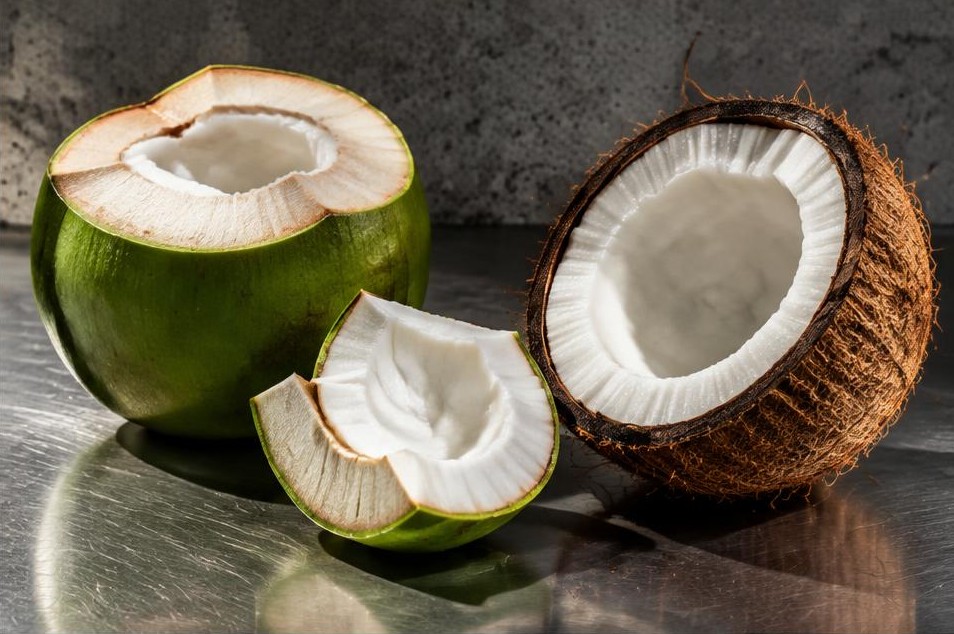
Imagine ordering a young coconut in Bo Phut. Someone opens the top and hands you a spoon for the soft flesh. Now turn to the official description of Koh Phangan Coconut, a fruit grown across the water. The shell should be dark brown. The flesh should be firm, creamy in flavour and dense enough to distinguish two layers. The grower is to harvest it at twelve months or older. It would make a curious specification for the coconut you have just ordered. It makes a great deal of sense to someone shopping for a good coconut to grate. 1
The name on the register is Koh Phangan Coconut, มะพร้าวเกาะพะงัน. Thailand’s Department of Intellectual Property gives it the registration number 56100047. Draw the boundary specified in the document and you get two subdistricts, Ban Tai and Ko Phangan, both in Ko Phangan district. A palm growing on Samui falls outside it. A market stall on Samui, of course, can sell fruit grown on either island. [1, 2]
What the cook wanted
It is worth reading the registration like a shopping list. It specifies local tall palms, good mature fruit for seed and harvest by the bunch. Up close, the inner layer of flesh is described as softer, while the outer layer is denser and rich in oil. The department’s illustrated account explains why traders valued that thickness. The fruit gave them plenty of kernel for coconut milk. It records Chinese merchants shipping coconuts from Phangan to Bangkok by sailing vessel and steamer. A merchant moving a hold full of hard shells had good reason to care how much lay inside each one. [1, 2]
A geographical indication, or GI, gives producers who meet a set of requirements a way to protect a name linked to the origin and qualities or reputation of their goods. Someone elsewhere can grow a tall coconut and grate its flesh by the same method. The part that belongs to the place is the right to describe qualifying fruit by the protected name. That leaves a cook free to prefer fruit from another island. It also leaves a grower in Ban Tai a way to have years of work recognised when a crate lands far from home. [1, 3]
You can even put a name to that work. On 28 August 2026, the department listed the Koh Phangan Coconut Farmers Community Enterprise as authorised to use the Thai GI emblem for this product. The published permission runs to 27 August 2028. The notice is one sheet long. It identifies a group a buyer could ask for by name and gives buyers a date after which to check the record again. 4
The second question to ask
Knowing the orchard still leaves the matter of what you want to eat. In a Kasetsart University study of Thai aromatic coconuts, horticulturist Nopporn Jaroonchon and colleagues followed fruit as it grew. They detected water at two months. At five months a thin layer of jelly appeared along the inside of the shell, spreading and thickening with age. For that aromatic coconut they put the appealing combination of texture, smell and flavour for fresh consumption at about six and a half to seven months. Their experiment concerned a different coconut from the local tall variety in the Phangan specification. Between them, the two sources explain how a seven month fruit and a twelve month fruit can each be somebody’s idea of perfect. [1, 5]
Samui has its own history to tell. Architecture researcher Chompunute Kongpoonpin traced part of it to the shore at Nathon, where Hainanese settlers used the waterfront to ship coconuts to China. What was grown, where it was loaded and where it ended up were different facts then, just as they are when you order breakfast today. 6
The person opening the shell may only know the last stop. Agricultural researcher Supinya Junmee and colleagues interviewed growers, merchants and coconut milk shop owners across three Thai provinces, including Surat Thani. Their study described collectors who might remove some or all of the husk, sell the kernel, or supply a processor. A seller who can name the collector has given you a real piece of information. The collector may be the person who knows the orchard. 7
So ask the questions separately. Where did this batch grow? What did the grower pick it for? If it is a young coconut for drinking, try a spoonful of the flesh while you still have the shell. If it is a mature nut destined for the kitchen, ask the cook what they look for when they open it. You might leave with the name of an island, a grower, or just a clear idea of why one coconut calls for a spoon and the other for a grater.
- Thai Department of Intellectual Property, original Koh Phangan Coconut registration and production specification, in Thai
- Thai Department of Intellectual Property, One Province One Geographical Indication, volume 5, printed pages 88 to 97
- World Intellectual Property Organization, geographical indications explained
- Thai Department of Intellectual Property, licence notice 827, 28 August 2026
- Nopporn Jaroonchon, Krisana Krisanapook and Wachiraya Imsabai, research on the development of aroma in Thai coconuts, 2017
- Chompunute Kongpoonpin, Development of Living Museum in Nathon Area, Samui Island
- Supinya Junmee and colleagues, field research on southern Thailand’s coconut supply chains, 2021